I can be a sucker for casual object games. They are a good thing to do when I’m trying to keep my mind occupied and often let me go into deep thought. It’s a lot like mowing the yard or listening to music – it keeps the noisy part of my mind occupied so another part can work on some more complex things.
One of these such games is Clutter. It’s a PC game and I found it on iwin.com. They have tons of casual games on that site and this is one of my favorites. It’s a hidden object game, but not in the strict sense. It’s almost more of a matching game. You have to find matches, sometimes two, sometimes three at a time. The game gives you different goals or modes. Sometimes the images are all in black and white or perhaps split in half. They also have mini-games scattered throughout to break up the game a bit.
There are five different Clutter games and I’ve played them each through a few times, some more than others. Clutter 1, 2 and 5 are my favorites. I have spent many, many hours playing. I was actually just playing Clutter 5 when I had the idea to write this post.
If you like hidden object or matching games, check this one out. It can be challenging and fun!
As I stated in my last post, I am a fan of city builders and Sim City. I liked Sim City original, Sim City 2000, Sim City 3000 and Sim City 4. So, naturally, I was really excited for Sim City (2013) and even pre-ordered it, as did my husband.
We picked it up on launch day, installed it and…didn’t get to play it. This game was an online-only game at the time, and Origin’s servers were overcrowded and down half the time. This was an omen of things to come. To their credit, about a year later, they did create an offline mode, so if your (or their) internet is down, you can still play.
Once we started playing, we were having fun. The game does do a lot of things right. I can’t say this is the worst game that I’ve played, but there were some things that killed it for me. Let’s start with the good. The graphics are great and you can zoom in to street level. It helps you feel more a part of your city. Your citizens also ask you for help from time to time and you get rewards for doing so. You have a nice selection of each item to build – for example, there are several different types of parks to add, all with their own rewards. You have another type of road to add, a multi-lane street (non-highway) which can be nice for traffic reasons. There are a myriad of special buildings to build. Overall, this still feels like SimCity, and that’s a good thing.
Now for the bad things. First, you are severely limited in your plot size. Their biggest size is way too small. This was the killer for me. I liked to make large, sprawling cities in the previous games. There are so many things to build, but you just won’t have room for half of them. Next, water is always a problem. You can still build pumps and water towers, but now the water depletes at a level that I felt was unrealistic. Yes, this is a problem that real cities face, but let me have some fun, too. Before 200 years, one of my cities was bone dry. Finally, pollution is also a constant problem. I had to destroy a lot of my buildings to make room for more trash facilities (see the small map size issue).
If you don’t mind the small city sizes, then you might enjoy this. It was just too crippling for my play style, so I can’t say that I would recommend this game to anyone.
Sim City has been around for so long that I played this in 7th grade. My school actually used this game to teach us about local government and city planning. I was hooked immediately and spent a ton of time playing Sim City original, often referred to now as Sim City classic. There have been many city builders since this one, but it was the original.
The graphics were basic, but the depth of the game was impressive. We were introduced to the three most common zones – industrial, commercial and residential. It was just those three, but the foundations were there. Residential folks didn’t like living next to industrial, you didn’t want to overdo the commercial, etc. Traffic was an issue, as it has been in every Sim City game to date, you needed to be careful with your fire station placement as it was critical and you NEVER removed funds from transportation or your advisor would get pretty angry.
The disasters actually made this one fun, too, as you didn’t have to have YEARS of recovery efforts to re-build. I always enjoyed making a UFO attack or have a violent earthquake ravage my city. It was so easy just to plop a new square down and watch it upgrade fairly quickly.
I still adore this game and play it from time to time. Its relative simplicity compared to the games that followed is refreshing, but it’s still a satisfying game. You can find this game online through free download or web-based pages. If you’ve not played this one before or for a long time, go back and do so!
I have seen a lot of my online friends playing a game called Garry’s Mod, so I thought I would try it out. I don’t understand the appeal at all. Here is the description of the game on their store page:
Garry’s Mod is a physics sandbox. There aren’t any predefined aims or goals. We give you the tools and leave you to play.
You spawn objects and weld them together to create your own contraptions – whether that’s a car, a rocket, a catapult or something that doesn’t have a name yet – that’s up to you. You can do it offline, or join the thousands of players who play online each day.
If you’re not too great at construction – don’t worry! You can place a variety of characters in silly positions. But if you want to do more, we have the means.
I played around with this for a few hours and just don’t get it. Sure, I can place items around the world, but then what? The world isn’t very big and appears to be set in the Half-Life 2 universe. I really like Half-Life 2, but this doesn’t even seem to be a game. Once you set things up, you can shoot them, I guess? I’m not out much as this was a $5 game. Please, if you have played it and like it, explain the appeal to me because I feel like I’m missing out.
I spent a good chunk of time reorganizing my office. Most of my collection is now in one area. I still have my 360, XBox original and XBone games out in the living room because that’s where those consoles are. I took a few pics. I’m putting close-ups of each section on the gaming gallery page. Here it is!
It’s floor-to-ceiling video games! And some work stuff, too.
My husband first introduced me to the Civilization series via Civilization III. I was immediately hooked and played that game A LOT. When Civ 4 came out, I was really excited and was not disappointed. The game really came together with the next two expansions, specifically Beyond the Sword.
This game is a turn-based strategy game, meaning that you make all of your moves during your turn, end your turn, and then all the other players take their turns. If you are playing other humans, this can make for a really long game, especially if you like to play on the huge maps like I do. For this reason, I only played multiplayer for maybe two games. I prefer to keep this a one-player game against computers. I do like a lot of opponents, however, and will often add up to 15 other civs, just to keep it interesting.
Everyone plays this game differently. My husband is a war-monger. I prefer a peaceful game and would rather win by cultural victory, democratic victory or space race. I tend to focus more on defense and democracy or theocracy than conquest. While my husband builds structures to aid in his military domination, I build the great wonders of the world and make sure that all of my citizens have access to theaters and universities. That is a part of what makes this game so great – you can play it a different way every time. The maps are different, the opponents all have their own personalities and tendencies and the game feels dynamic. You can pick which era you start in, how many years go by with each turn, what the general climate of the world is and so many more things!
Your ultimate goal is to win by several different means – cultural, space race, conquest, democratic, domination or score (if you can’t achieve any of the others). You start with a single settler and military unit. You found your city and start building items to help you grow as a nation. The early exploration is one of my favorite parts of the game. There are primitive huts that you can find that will give you a surprise. They usually help, but not always. As you play, you research technologies which allow you to build new and better things. The tech tree is large and highly customizable:
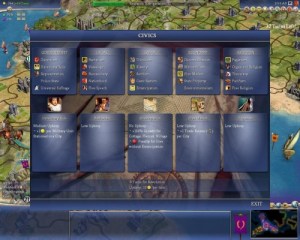
There are also many civic combinations to try to play to your civ’s strengths and weaknesses:
Another big part of the game, especially for a cultural player such as myself, is religion. It is a powerful tool to earn allies or enemies. I always try to race to get Hinduism first and then use great wonders to get quick religions early. I’ve found that if you own the foundations to as many religions and spread only the one that you want, a cultural victory is nearly guaranteed. A democratic victory is also within your grasp if you build the apostolic palace early. You can build the UN later in the game, too, and try for a democratic victory that way.
Anyway, this game is awesome and I strongly recommend it to anyone who enjoys map-based games. It has endless replayability and I still play it regularly. My husband plays this near-exclusively still. We did not like Civ5 and you can find my reasons for that here.
I started playing EverQuest 2 the day it was released. I lived in Hawaii at the time but was in Wisconsin visiting friends and family. It was November of 2004. I had long been an EverQuest 1 player and was excited for the upgrade. I would not be disappointed and would end up playing this game for over 1,000 hours.
EverQuest 2 takes place hundreds of years after EverQuest 1. The game is a massively multiplayer online role playing game, or MMORPG, or MMO for short. You create a character from scratch and fight your way through the world, either on your own or with other players. As you fight, you get better items and abilities. New areas are available to you as you level up. The character creation process is fun and they give you a good amount of customization.
EQ2 fixed many of the problems that plagued EQ1 such as, you know, QUESTS. EQ1 was often called NeverQuest as the quests were fewer and hard to find. There were no indicators showing who had something for you to do. Instead, you were forced to talk to every NPC (non-player character) and see if they might have something for you. EverQuest 2 fixed this. There were icons above the NPCs that had quests to offer. And there were thousands of them. And I did thousands of them!
The graphics were also excellent for the time. EQ2, however, would always be compared to another small game that came out at the time – World of Warcraft (WoW). EQ2 actually came out a couple of weeks before, but WoW would eclipse EQ2 in the MMO community. The result was actually positive for EQ2 players as a lot of the more novice players played WoW, leaving us with a more mature player base and a more enjoyable experience. If you ever played WoW, you know exactly what I’m talking about.
The world of Norrath was huge and exciting. They regularly added content and expansions. I still play from time to time, but my character, a brigand (rogue) is currently level 95. I’m not sure what the cap is now, but it was 95 the last time I played. It is easy to level up, which some saw as a negative, but I thought was more fun. It was also a more solo-friendly game than EQ. Again, there is a lot of debate about whether this was good or not. I personally preferred it, but others thought it ruined what made EQ1 so great – socializing with other players.
The crafting system in this game is also the best I’ve played. It;s more like a mini game than a mundane crafting system. And the items you create are actually useful and better than what you can get in most spots. I have a chef that I leveled up to at least level 90. There is also player and guild housing, which can be fun if you want to sink the time and (in-game) money into it.
As I stated, the game is still around and I believe it’s free to play now. If you’re looking for a fun MMO with a LOT of questing and leveling, check it out. I’d love to see others enjoy this game as much as I did and experience before it’s gone. There was going to be an EverQuest 3, called EverQuest Next, but after Sony sold the franchise, it was scrapped. That’s too bad, in one way. In another, I’m kind of glad because I just don’t have the time and energy to go through another obsession like I did with EQ2.
Titus the Fox was a platformer from way back in 1991. We had it on our Windows 3.1 computer when I was a kid and I think this was my sisters’ favorite. At least, I hope so, because when I tried to copy it for a friend and rendered the disk useless due to some copyright code, they almost killed me. Let’s discuss why.
Titus was a cute game and took place somewhere in the middle east where magic carpets are the norm. You play as the fox and are trying to get to the end of each level in search of your female counterpart. But she’s always in another castle somewhere else and you need to keep running through a gauntlet of baddies. If I recall, your primary mode of attack is picking things up and throwing them – including the bad guys. If you could approach them from behind, you could throw them. There was usually some sort of stacking puzzle in the level as well.
It was a fairly standard platformer, but the graphics were pretty good for a 1991 computer game running on 3.1. The soundtrack was cutesy as well. I can see why my younger sisters liked the game and I would like to formally apologize for destroying it. I’m glad you’ve grown up without too much mental scarring as a result of my technical ignorance.




 Super Fun Time Video Gaming Girl! Now Playing...